The Federal Reserve has just delivered another 25 basis point (bps) cut to the Federal Funds rate, a move the market saw coming with near-certainty (90% confidence). However, the devil was in the details—and the vote count.
The Fed’s Tightrope Walk: Dissension and the 3.50% – 3.75% Target
The final decision, which brings the target rate to 3.50% – 3.75%, was not unanimous, ending with a 9-3 vote.
- Dissenters: Two governors voted to keep rates unchanged, while one pushed for a more aggressive 50 bps cut. This internal debate highlights the current uncertainty facing the central bank.
- The Big Picture: This latest move is part of a substantial easing cycle, totaling a 125 bps reduction since September 2025 and 75 bps over the last three meetings.
Chairman Powell’s message remains consistent: further rate cuts are not guaranteed. The Fed is juggling its dual mandate: supporting maximum employment and returning inflation to its 2% target. Right now, inflation seems to be their primary focus.
The Economic Data Backdrop
The Fed’s caution is understandable given the mixed economic signals:
- Inflation is Sticky: The latest CPI report (through September) shows both headline and core inflation running at 3.0% year-over-year, still modestly above the 2% goal. Services inflation, like rent, is proving particularly stubborn.
- Jobs are Cooling: The November jobs report (data through September) showed a modest payroll increase of 119,000, which is “little change since April.” This softer jobs picture is generally supportive of further rate cuts.
- Growth is Resilient: Preliminary Q3 2025 Real GDP growth estimates are strong—ranging from 3.8% to 4.2%. Solid consumer spending and business investment suggest the economy is “slowing but not stalling,” giving the Fed room to pause and evaluate its next move.
The Yield Curve and the “K-Shaped Economy”
The current rate environment is producing an upward sloping yield curve. While short-term rates are declining (a boon for borrowers), long-term yields remain stubbornly high, reflecting investor concerns about medium-to-long term inflation and economic uncertainty.
A critical risk factor remains the “K-shaped economy.” Stress on lower-quality credit (especially subprime) and lower-income households contrasts sharply with the high asset values (like the near all-time high equity markets) that benefit wealthier individuals. Any acceleration of credit losses could quickly tighten financial conditions.
- Short-Term Forecast: The market expects 1-month term SOFR to initially trade in the new target range of 3.50% – 3.75%. Forward projections suggest further easing, with the index potentially bottoming out around 3.00% by Summer 2026 before moving up again.
Commercial Real Estate: A Market on the Move
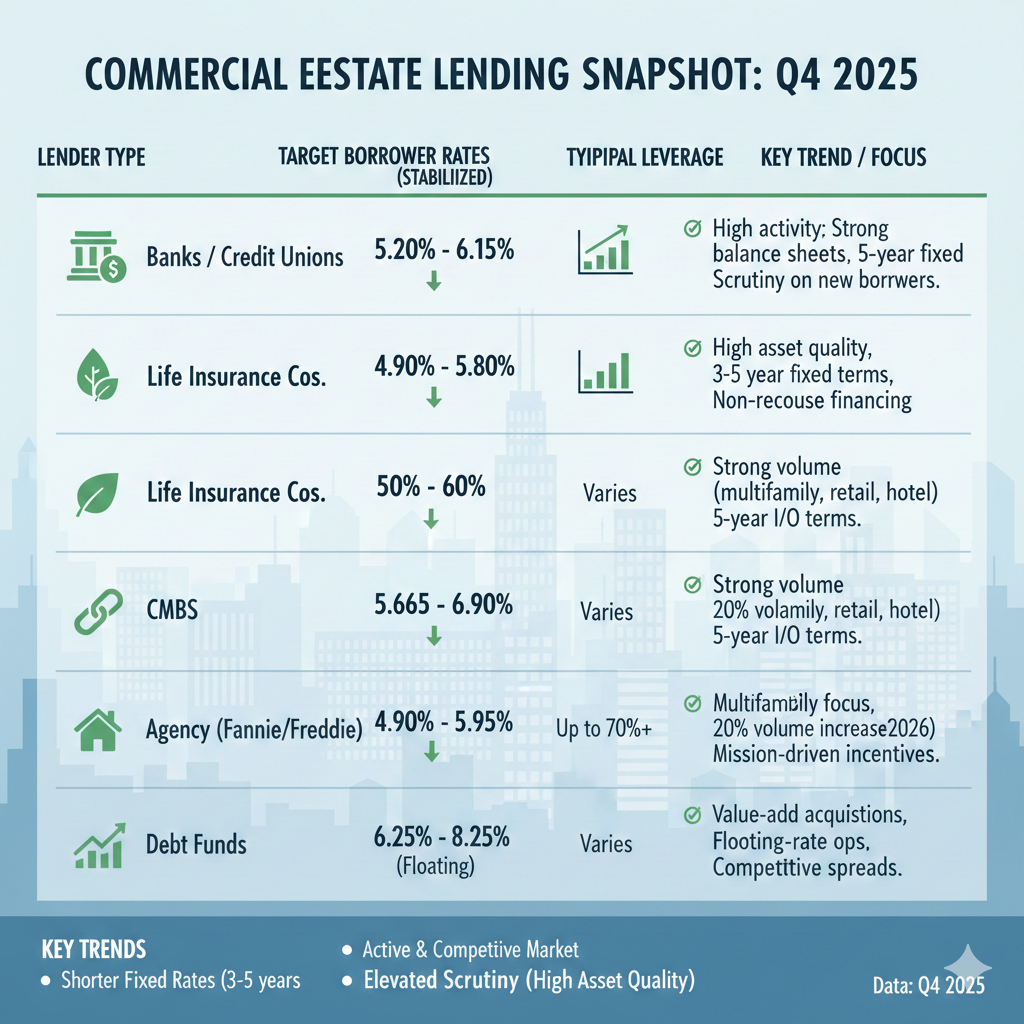
Despite the macroeconomic uncertainty, the capital markets for commercial real estate (CRE) lending are showing significant signs of improvement. Lender production targets for 2026 are uniformly higher, and competition is driving down spreads and borrowing rates, particularly on the short end of the curve.
The general trend: Activity is picking up, with stabilized lending rates for most transactions now in the 5.00%-6.25% range.