
Former Sparkletts property receives historic status, ensuring its unique architecture remains part of the community’s future.
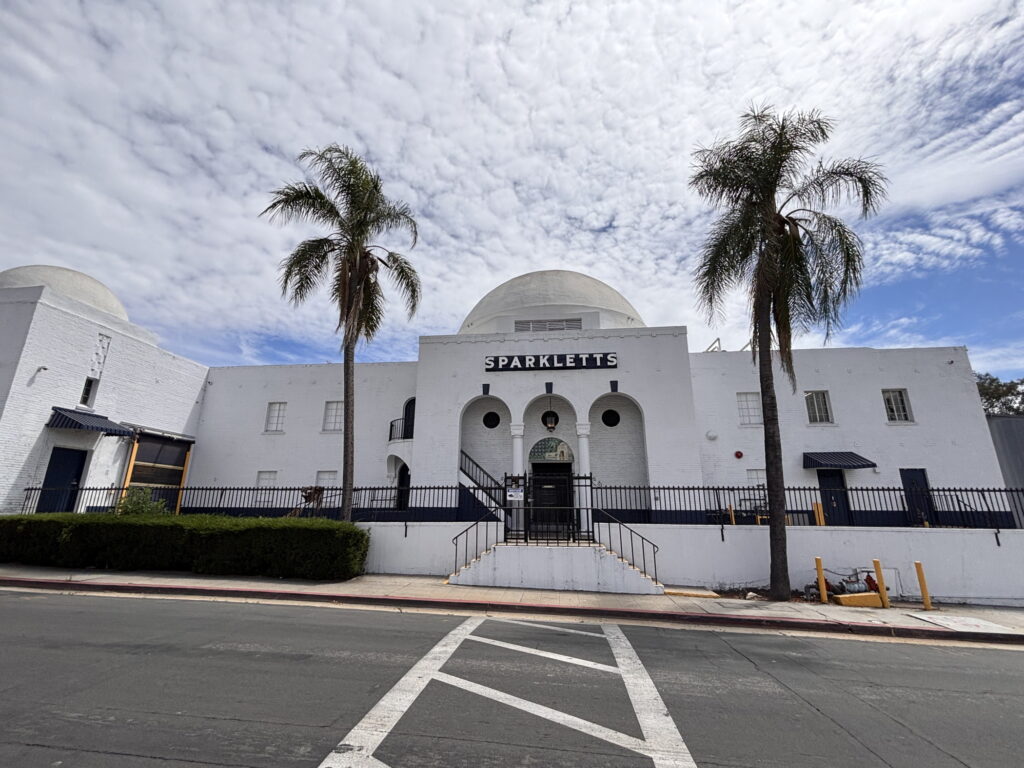
A well-known landmark in Northeast Los Angeles has been officially protected after local residents successfully pushed to preserve the historic former Sparkletts Bottling Plant instead of seeing it replaced by a large apartment complex or data center.
The Los Angeles City Council has approved historic-cultural monument status for the property at 4500 E. Lincoln Ave., safeguarding the iconic complex that was originally built in 1929. The designation follows the end of water bottling operations in 2025, when property owner Primo Water closed the facility.
Although the nearly eight-acre site is now being marketed for redevelopment, any future project must retain the property’s most significant historic features and comply with additional preservation requirements. This creates a unique challenge for developers looking to give the aging industrial site a new purpose while maintaining its architectural identity.
Unlike a conventional manufacturing facility, the former Sparkletts plant is recognized for its distinctive Moorish Revival architecture. Designed by architect Richard D. King, the complex features decorative domes, ornate tilework, wrought-iron details, and minaret-inspired elements, making it one of the few remaining industrial buildings of its kind in Los Angeles.
The property’s preservation comes at a time when many older industrial buildings across Los Angeles are being redeveloped for new uses. At the same time, proposals for new data centers have faced growing community concerns over electricity demand, environmental impacts, and neighborhood compatibility.
Real estate experts believe adaptive reuse is becoming an increasingly practical solution for older industrial properties that no longer meet the requirements of modern logistics and manufacturing. Patrick Barnes, Managing Director at Avison Young, said these sites can often find new life through creative redevelopment rather than demolition.
While industrial properties are frequently criticized because of truck traffic, pollution, and land-use disputes, the former Sparkletts facility received widespread backing from local residents, historians, and preservation groups. Supporters argued that its historic character should be viewed as a valuable asset rather than an obstacle to future investment.
Barnes noted that the building stands out in the industrial real estate market because of both its unique design and its location within a rapidly evolving neighborhood.
Located between Highland Park and Eagle Rock along the Arroyo Seco corridor, the surrounding area has gradually transformed from an industrial district into a vibrant community featuring new housing, restaurants, creative businesses, and mixed-use developments. As the neighborhood evolved, many residents came to see the former bottling plant as a defining symbol of the community.
During public discussions, representatives from the Eagle Rock Valley Historical Society emphasized the importance of preserving the landmark for future generations, regardless of how the property is ultimately redeveloped.
Preservation advocates also argued that protecting the building does not prevent redevelopment. Instead, they believe the site could successfully accommodate residential projects, commercial businesses, recreational facilities, or light industrial uses while maintaining its historic architectural identity.
Market data also highlights the growing redevelopment pressure facing older industrial properties. Over the past decade, less than five percent of Los Angeles County’s industrial inventory has been newly constructed, well below the national average. Although millions of square feet of industrial space have been added, large amounts of older inventory have also been demolished, resulting in only modest overall growth.
Barnes explained that many manufacturers now find it more cost-effective to produce goods outside California and transport them into Los Angeles, reducing demand for older industrial facilities that cannot compete with newer logistics-oriented buildings.
Sparkletts originally began operations in 1925 as the Sparkling Artesian Water Company, helping popularize home and office water delivery long before bottled water became a mainstream consumer product. Four years later, the company opened its nearly 150,000-square-foot headquarters and bottling plant, which served as its corporate home until 1991 and continued production under several owners before operations ended in 2025.
The Los Angeles Conservancy supported the landmark designation, describing the complex as one of Southern California’s finest examples of Moorish Revival industrial architecture. City officials also concluded that the site deserves protection because of both its architectural significance and its important role in the history of the region’s bottled water industry.
Looking ahead, experts believe the property’s future may involve flexible industrial space, creative research and development facilities, or an adaptive reuse project that successfully blends historic preservation with modern commercial opportunities.
Source: Original reporting by Brannon Boswell, CoStar News.