
Strong warehouse demand and slower construction are helping Lakeland’s industrial market recover from recent oversupply.
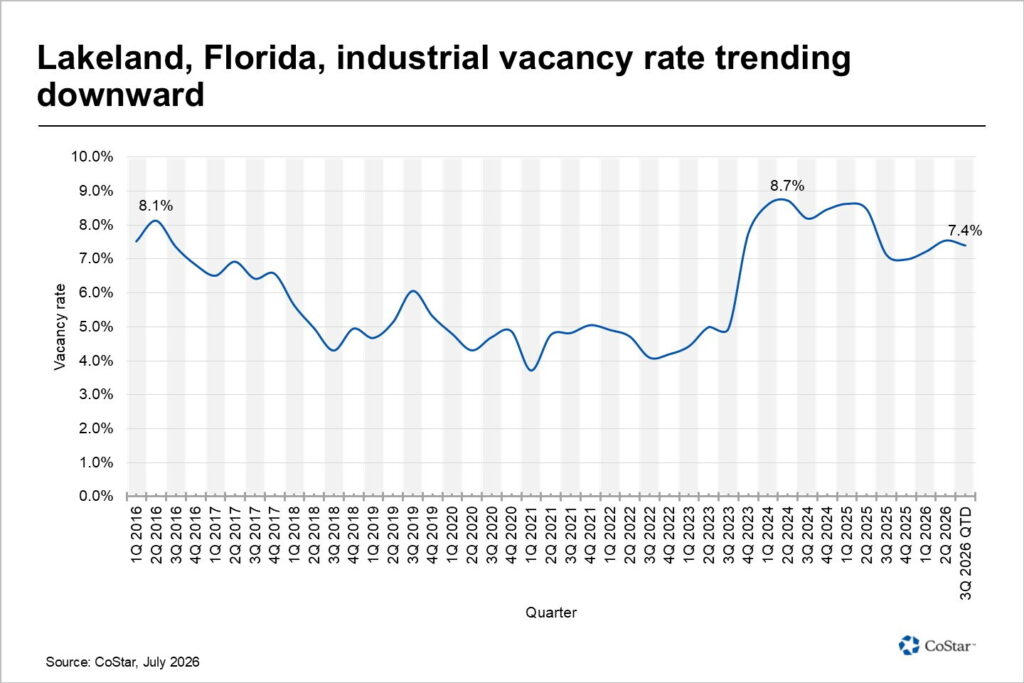
Lakeland’s industrial real estate market is continuing its recovery as vacancy rates decline and tenant demand strengthens. After experiencing a surge in new construction over the past few years, the market is now benefiting from increased occupancy and a slowdown in development activity.
The current industrial vacancy rate stands at 7.4%, a noticeable improvement from the 9% peak recorded in mid-2024, which marked the highest level in more than a decade. Over the past year, tenants absorbed approximately 2.4 million square feet of industrial space, while developers completed about 1.7 million square feet of new inventory. This marks the first time since 2022 that leasing demand has exceeded new supply.
Several major warehouse leases have played a key role in reducing vacancy. One of the largest transactions was PepsiCo’s 1.2 million-square-foot lease at Central Florida Integrated Logistics Park, which removed one of the state’s largest vacant industrial properties from the market. Additional large warehouse commitments from companies including Monster Energy, PECO Pallet, and an undisclosed e-commerce business have further strengthened occupancy levels across the region.
Although these large-scale leases have attracted attention, smaller businesses continue to provide the market with a stable source of demand. During the past year, roughly 1.2 million square feet of leasing activity came from tenants seeking industrial spaces smaller than 50,000 square feet. This segment has remained consistently active even as demand from larger occupiers has fluctuated.
The steady flow of smaller leases has helped support overall market performance. However, Lakeland’s long-term vacancy outlook remains heavily influenced by the leasing performance of its largest warehouse and distribution facilities.
Currently, just four industrial buildings account for nearly one-quarter of all available warehouse space in the market. Even so, local leasing professionals remain optimistic that many of these large vacant properties will secure tenants before the end of the year as demand from major distribution and logistics companies continues.
If these large spaces are successfully leased, Lakeland’s industrial vacancy rate could decline even further in the coming months.
Meanwhile, construction activity has slowed significantly compared with previous years. Approximately 1.5 million square feet of industrial space is currently under development, a sharp decrease from the more than 5.5 million square feet that was under construction during the market’s peak development cycle in 2020.
The largest active project is a 608,000-square-foot warehouse being developed at Central Florida Integrated Logistics Park in Winter Haven. Aside from this facility, only two additional industrial projects larger than 100,000 square feet remain in the current construction pipeline.
The reduced level of new development should help ease competitive pressure across the market in the near term. However, most of the space currently under construction is being built on a speculative basis, with only about 25% preleased so far. As a result, future occupancy growth will largely depend on Lakeland’s ability to continue attracting major warehouse, logistics, and distribution companies that have fueled the market’s expansion in recent years.
Source: Original reporting by Michelle Rumore, CoStar News.